Showing posts with label techno thriller. Show all posts

Wednesday, May 15, 2019

"Deep Past" by Eugene Linden


EXCERPT and GIVEAWAY
Deep Past
by Eugene Linden
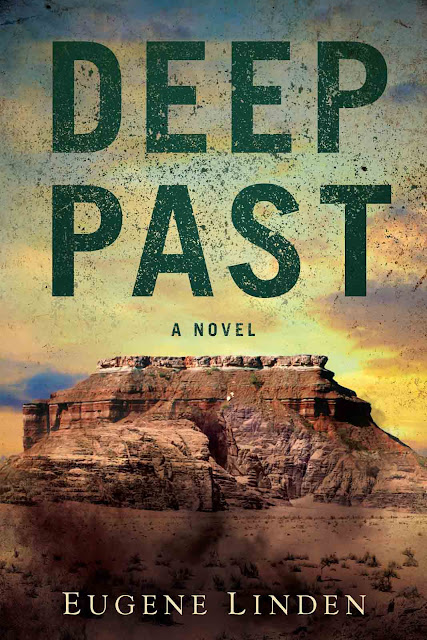
Deep Past by Eugene Linden

Deep Past by Eugene Linden is currently on tour with Great Escapes Virtual Book Tours. The tour stops here today for an excerpt and a giveaway. Please be sure to visit the other tour stops as well.


Description
If nature could invent intelligence of our scale in a blink of geologic time, who’s to say it hasn’t been done before …
A routine dig in Kazakhstan takes a radical turn for thirty-two-year-old anthropologist Claire Knowland when a stranger turns up at the site with a bizarre find from a remote section of the desolate Kazakh Steppe. Her initial skepticism of this mysterious discovery gives way to a realization that the find will shake the very foundations of our understanding of evolution and intelligence.
Corrupt politics of Kazakhstan force Claire to take reckless chances with the discovery. Among the allies she gathers in her fight to save herself and bring the discovery to light is Sergei Anachev, a brilliant but enigmatic Russian geologist who becomes her unlikely protector even as he deals with his own unknown crisis.
Ultimately, Claire finds herself fighting not just for the discovery and her academic reputation, but for her very life as great power conflict engulfs the unstable region and an unscrupulous oligarch attempts to take advantage of the chaos.
Drawing on Eugene Linden’s celebrated non-fiction investigations into what makes humans different from other species, this international thriller mixes fact and the fantastical, the realities of academic politics, and high stakes geopolitics - engaging the reader every step of the way.

Excerpt
1
By expedition standards, the Quonset was relatively snug, albeit stiflingly hot. The wind from the steppes howled outside as it had for three days, confining the archaeological team to their huts. It was late May, a time of year when temperatures were soaring and dust storms frequent as the winds picked up dirt and sand from the desert.
Still, only stray bits of grit blew in on those occasions when Claire had ventured out to the mess during the storm. The hot air in Claire’s hut was dry enough to mummify the plum Claire had left sitting in a bowl. She had pretty much stripped down as she sat at her plywood desk. She thought back on the whirlwind of events that in a few short weeks had brought her from a wellestablished life doing research in Florida to the searing heat of the Kazakh Steppes. It had all begun with a site visit from her funders, a visit that had gone well—too well, as it turned out.
She thought back to the day.
One of the sweetest moments was the shower demonstration. Claire smiled as she thought of baby Teddy.
“No, no, sweetie, you’re doing it all wrong.” Claire had walked over and pushed the lever.  “See,” she said, looking into the soft brown eyes of the toddler, “you push the lever and the water comes out.” Claire had extended her arm to push a long handle so that she didn’t get doused by the shower. The baby cocked his head and looked at Claire expectantly but didn’t reach for the lever.
Claire sighed and turned behind her. “Come here, Mona. Why don’t you try.”
At the mention of her name, Mona, who had been standing placidly by, perked up and began lumbering forward.
Claire turned back to the baby. “OK, Teddy, Mommy’s going to show you how.” Then she nimbly and quickly stepped back to make way for the massive elephant.  Mona walked under the twelve-foot-high showerhead in the enclosure and pushed the lever with her trunk. She gave a soft rumble of pleasure as the cool water offered relief from the hot Floridian sun. Then she stepped back and, with her trunk, gently nudged baby Teddy forward.
Teddy looked at Mona, glanced over at Claire, and then at the lever. Mona emitted another soft sound and put her trunk on the lever. Teddy tentatively extended his trunk and put it on the lever, too. Then Mona pushed the lever and water gushed down on the five-hundred-pound baby. Teddy jumped and gave an alarm call.
Claire laughed. She turned to two men and a woman standing behind protective mesh and said, “I know I shouldn’t say this, but I’d guess Mona was laughing, too.” That produced chuckles in the group, who were sweltering in business attire and mopping their brows with handkerchiefs.
Claire took pity. “OK, let’s get out of the sun, and we can talk about the real work going on here.”
Later, as she waved goodbye, Claire had skeptically replayed the site visit. Not knowing what it was really about, she’d thought it had gone well. On surprisingly short notice, the Delamain Foundation, which funded her work, had sent a group of two trustees and the executive director to visit. Claire knew where her bread was buttered, and she’d made sure to mix the hard science—experiments to determine what information elephants conveyed through ultrasonic communication, and how they perceived it—with the fun stuff.
They’d loved the fun stuff.
Apart from the shower demonstration, Claire had set up a pitching contest between one of the elephants, Flo, and one of the volunteers at the park who had previously played baseball in high school. Delamain was headquartered in Chicago, and so Claire had put a Chicago Cubs blanket on Flo’s back. The first two times she tried to put the blanket on, Flo shook it off. When Flo finally seemed to accept that Claire was determined to keep the blanket on her back, Claire patted Flo behind her huge ears before climbing down, saying, “You could have told me earlier that you’re really a Mets fan.”
Separated by a wire mesh, the elephant and a somewhat nervous volunteer had taken turns trying to throw softballs through a tire about forty feet away. Flo was rewarded with a treat for every successful throw, as well as lusty cheers from the Delamain delegation. While the delegation was delighted and dumbfounded when Flo won, Claire was not surprised. She knew that Flo’s favorite game was throwing things. Indeed, the reason Flo had ended up at the park—which had been set up to serve as a refuge for superannuated elephants—was that one of her games in her former life at an Ohio zoo had been to throw rocks at the monorail that brought tourists through the elephant enclosure. Her unnerving accuracy had properly unnerved the administrators. Once Flo had arrived, Claire had set up the tire as a way of redirecting Flo’s interest in throwing things in less destructive ways.
Following the Delamain group’s departure, Claire stopped by the trailer where the postdocs and grad students were collecting and analyzing data. She thanked them for taking the time to explain their work.
“Should I be polishing my résumé?” asked Thelma, an acoustic specialist from Arizona State.
Claire smiled. She had really promoted the team, telling the delegation that the project basically ran itself. She’d noticed that when she made that point, one of the trustees had caught the eye of the other and arched an eyebrow. What was that about? With the vantage of hindsight, Claire now realized that this should have put her on full alert. At the time, though, she had simply thought that the trustee was signaling that he’d been impressed. That’s what she told the staff.
“I think we’re good for the duration. Fingers crossed, anyway.”
“Hope so,” said Pete, a statistician and pattern recognition expert, “and if it’s so, I’d bet it was Flo, not us, who sealed the deal.”
Claire shrugged amiably. He was right. “Could be, but they’re not funding Flo’s baseball career. They’re funding us—you. This is good, solid work, and you all should be proud.”
She then took her leave and stopped by to thank Flo and Mona, but mostly to spend a few moments with Teddy. She couldn’t get enough of Teddy, who was, without success, chasing a flock of squawking geese. Teddy’s earnest clumsiness had endeared him to every elephant and human he encountered.
The park was situated on land donated by an elephant-loving farmer, and a converted bunkhouse served as Claire’s lodging. That evening, with a warm breeze rustling the palmettos, Claire sat on her tiny porch, sipped a glass of wine, and took stock of her situation.
Sitting in the Quonset, Claire shook her head at her naïveté of just a few weeks earlier. Back then, she’d thought she was set on a solid career path. She had settled in to the work and her experiments. The team was producing pioneering research on ultrasonic communication. Byron Gwynne, who was writing a comprehensive and highly anticipated monograph on elephant evolution, had written that he would be citing one of her papers. And the head of the Center for the Study of Evolution at Rushmere University, where she was attached as an adjunct professor, had told her that if she continued producing solid research, she was up for a tenure track associate professorship.
She had made compromises. She’d had to put aside the study of animal intelligence—her true passion—but she felt well situated for a productive career in academia.
A slight frown had wrinkled her features as she considered her romantic life, which might best be described as idling on care and maintenance. It consisted of an on-again, off-again, long distance relationship with an utterly unreliable writer (they’d met when he interviewed her for an article on elephant communication—he called her for what he termed “follow-up” two weeks after the article was published).
It was something of a wonder that the relationship continued at all. True, John was very funny, which ranked him high in the attributes Claire considered important, and he was anathema to her mother, which also gave him a certain cachet. Her mother would regularly send her clippings about how writers earned less than baristas at Starbucks—hell, Claire thought, many were baristas at Starbucks—while reminding her that she was thirty-two and not getting any younger.
Or, as her mother, with her inexhaustible store of mixed metaphors, had phrased it, “You don’t want to be rushing for the train after the ship has left port.” With regard to the prospect of children, her mother had a point, though Claire would have happily co-parented with Mona and devote her maternal feelings to raising Teddy to be a successful young elephant. She smiled at the thought of her mother’s expression if she presented that idea. John would probably start looking pretty good in her mother’s eyes.
Human factors notwithstanding, Claire had thought she was in a good place. In a world where talented scientists scrambled for any work, she had a good position and it involved meaningful research. If she played it right, a tenured professorship could be hers. She decided that she would put her all into that prospect. Then she might turn her attention to upgrading her love life. In truth, her mother needn’t worry about her marrying John. She smiled at the thought of how John, who had a very lofty opinion of his place in the universe, would react if he knew that he was serving as a placeholder. “Don’t screw things up,” she murmured to herself as she took her last sip of wine.
[Want more? Click below to read a longer excerpt.]


Praise for the Book
Deep Past is an extraordinary novel on so many levels. It is a gripping thriller in terms of pacing, vivid characters, and exotic settings, a book you won't be able to put down. It is also one of those rare novels that bends (if not blows) the mind with deep and compelling ideas about consciousness, intelligence, and our place in the world. The very real and accurate science in this novel will give you the intellectual shivers and stay in your thoughts long after the book is finished.” ~ Douglas Preston, #1 New York Times bestselling author
“An excellent thriller with real meat on the bones ... makes you think as well as sweat.” ~ Lee Child, #1 New York Times bestselling author
“A fascinating thriller ... Linden does a masterly job of integrating intriguing speculative science into a page-turning plot.” ~ Publishers Weekly

About the Author
Eugene Linden
Eugene Linden is an award-winning journalist and author on science, nature, and the environment. Deep Past draws on his long career in non-fiction as the author of ten books, including his celebrated works on animal intelligence and climate change: Apes, Men, and Language, the New York Times “Notable Book” Silent Partners, and the bestselling The Parrot’s Lament. His book, The Winds of Change, which explored the connection between climate change and the rise and fall of civilizations, was awarded the Grantham Prize Special Award of Merit. For many years, Linden wrote about nature and global environmental issues for TIME where he garnered several awards including the American Geophysical Union’s Walter Sullivan Award. He has also contributed to the New York Times, Foreign Affairs, and National Geographic, among many other publications.

Giveaway
Enter the tour-wide giveaway for a chance to win one of three print copies of Deep Past by Eugene Linden (US only).

Links

Featured in this post:


Wednesday, December 2, 2015

"Terminal Connection" by Dan Needles

EXCERPT
Terminal Connection
by Dan Needles


Dan Needles, the author of Terminal Connection, stops by to share a guest post and an excerpt from his book.

Description
What if a terrorist were a computer virus, its weapon a defect, and its target the U.S. military's eyes and ears? Welcome to post 9-11 where the lines are blurred between terrorists and superpowers, military and civilian, and virtual and reality. In a war of information everyone is on the frontline.
That's inventor Steve Donovan's nightmare in this technology thriller Terminal Connection.
Moving between reality and virtual worlds, the players in this high-tech, espionage thriller, find danger and death in both worlds. NEXUS Corporation has developed a virtual technology, but a hacker has introduced a deadly virus - a killer who moves through the virtual world paralyzing his victims and taking their lives; but with this virus, virtual death results in real death. Can Steve, the developer of this technology and founder of NEXUS Corporation, find the virtual killer and stop the virus before he becomes the next victim of a technology that will give world power to one man?
Readers who enjoy espionage thrillers, technology thrillers, and military science fiction will find that Needles has woven an intricate plot with characters who are entangled in high-end technology, military secrecy, corporate and political espionage. Needles' intimate knowledge of high technology, secret government and corporate contracts is evident. Terminal Connection is a work of fiction, a novel; but it's clear that Needles understands the world he's written about.

Excerpt
Chapter 1
Monday, June 29, 2019
Steve slammed the office door and stormed through the parking lot toward his black Mustang. Behind him, footsteps slapped against the wet, dark asphalt. Unbelievable. Jack was following him.
Through the steam rising off the hood from the idling engine, Steve squinted into the Mustang’s headlights. He saw only shadows through the rain streaked windshield and held up his hand to tell his wife and daughter to stay put.
Jack Wheeler stepped into the light. “Now son, come back inside. Let’s talk about this.” Fifteen years Steve’s senior, Jack was clean-shaven with a short crew cut. The man stared down at him from his six-foot muscular frame.
Steve felt older than his thirty-five years. From his average build and height he couldn’t help but feel intimidated by Jack. The encounter would surely add additional premature streaks of silver in his already graying brown hair. One thing he knew for sure—Steve couldn’t trust Jack; not anymore. “We’re done talking,” Steve said.
Jack stretched out his arms. “It’s just a VR-enabled Internet browser. It’s supposed to have glitches.”
“Not glitches that kill. The Nexus isn’t ready.” Steve wiped the rain from his brow. He stole a glance at his watch. Seven-thirty.
Jack laughed. “Imagine the scenario you’re worried about. The patch has to fail, followed by an energy surge.”
“Followed by a seizure and death,” Steve added. He looked through the steam that rose from the car hood to its occupants. Tami was going to be pissed.
Jack shook his head. “Son, we might also get hit by lighting. You might get in a car wreck. What’s the difference?”
“We can prevent this, Jack.”
Thunder rumbled above them. The sky had turned darker and the drizzle threatened to turn into a downpour.
Jack wagged a finger. “The release date cannot slip.”
“Really?” said Steve. “Last time I checked I was the CEO.”
“You can’t do this,” Jack said.
Steve turned and headed to the driver’s side. Pellets of rain stung his face as the storm intensified.
“Bankruptcy is around the corner. Things are in motion that I can’t stop,” Jack shouted after him.
Steve shook his head. How could I have selected such an immature bastard for a partner? Tami had warned him. He should have listened to her. Now millions of dollars into the relationship, he couldn’t turn back.
Thunder cracked above.
“We’ll talk Friday after I’ve had time to test things out,” Steve shouted back. He opened the car door and put one foot in.
“Don’t,” Jack said. He had dropped his southern drawl.
Steve met Jack’s scowl.
“Steven?” said Tamara.
He turned to her. “What?”
She raised her eyebrows.
“I know. We’re going,” Steve said.
In the backseat Brooke stared through the rain-streaked window.
“Come on, son,” Jack shouted. “One more round for the road.”  He waved back toward the office.
“We’ll finish this in the morning.” Steve sat down in the driver’s seat.
“Don’t do it. I’m warn….”
Steve slammed the car door. That felt good. A smirked formed but melted as he turned and faced his wife.
She stared down at her watch and frowned.
“What time is it?” he asked. He already knew the answer. Steve put the car into reverse.
“It’s 7:30. The play begins in half an hour.”
“I can’t be late for this,” Brooke whined. The teenager leaned forward from the backseat.
Steve met her gaze in the rearview mirror as he drove forward. “Get your seat belt on.”
“I’m sure your father will make up the time,” Tamara said.
Steve winced. Crow Canyon Road was tough even without the stormy night. “Tam, I….”
Tamara sniffed his breath. “You’ve been drinking,” she said in a low voice.
He shook his head. “Only a couple.” Steve looked into the rearview mirror. Brooke remained perched forward.
“Whoa. Do you drink, Dad?” Brooke giggled.
“Get your seat belt on,” he shouted.
Brooke slumped back into the seat and crossed her arms. Steve took a deep breath and pulled onto the road. He felt a hand on his arm. “It’s no big deal,” Tamara said.
He nodded. The argument with Jack had gotten to him.
Bright headlights shined through his window and a horn blared.
Tamara gripped his arm. “Steven!”
He gunned the engine and negotiated the turn. The oncoming car missed the back end of the Mustang and the car fishtailed. After a second, he regained control.
Brooke’s seat belt clicked in the backseat.
Tamara laughed. “Your father will get us there, hopefully in one piece.”
Steve read the time on the dashboard and frowned—thirty miles in thirty minutes. He pressed down the accelerator and made the most of the 100-yard straightaway.
Tamara leaned over and lowered her voice. “Tell me, really. How much did you have to drink?”
“Only two or three.”
She dipped her head forward and raised her eyebrows.
He laughed. “Really.”
She smiled. The car rounded a corner. To humor her, he eased off the gas and applied the brakes. The car continued to accelerate.
Steve’s heart rate took off and he punched down the brake pedal. Nothing. His stomach felt sick.
“Something’s wrong,” he said.
“Dad?” Brooke asked.
“I’m working on it.” Jesus. He pumped the brakes. The car continued to accelerate, and the back tires squealed.
“Lock your door,” Tamara said.
Steve heard a click as Brooke complied.
The back end of the Mustang slid out. Steve steered into the slide and the car crossed into the opposing lane. He pumped the brakes. Nothing. As the car drifted toward the guardrail and the chasm, Brooke and Tamara remained quiet.
The road straightened and the wheels stopped squealing. He steered back to his side of the road and glanced at their speed—50 miles per hour. How had they survived? The road pitched downward, and the car accelerated. A steep cliff rose to the right and to their left was a deep canyon. He had no place to safely ditch the car.
“What’s happening?” Brooke cried.
“Quiet. Let your dad focus.”
Steve glanced at the speedometer. The car passed 60 miles per hour. A sign warned of a 30-mile-per-hour turn.
“Shit,” Steve yelled.
“Emergency brake!” Tamara shouted.
He reached down with his right hand and yanked on the brake. The arm didn’t budge.
The car entered the next turn, and Steve grabbed the wheel with both hands and managed to stay on the road. He exhaled. Foreplay—the real curve was still ahead.
“Tam, some help, please!” he yelled, glancing at the emergency brake.
“Oh, God!” Brooke screamed.
Tamara reached over and yanked the lever. It didn’t budge. She undid her seat belt and took hold of the brake with both hands.
“Hold on,” Steve shouted. As the car entered the turn, he steadied the steering wheel with his left hand. With his right he grabbed the emergency brake and yanked with Tamara.
Snap. The lever flew back.
The rear wheels lost traction and the car spun. Tamara flew back and then forward, her head slamming against the passenger window.
He turned into the spin and regained control.
“Mom!”
Steve could hear Brooke fumble with her seat belt.  ”Don’t!” he yelled as the car began to fishtail again. Steve gripped the steering wheel with both hands and turned into the spin. They were traveling too fast.
“Tam!” he shouted. “Buckle up!” She didn’t open her eyes, and blood was smeared on the window where she had hit her head.
“Tam!” he yelled, and looked up into the rear view mirror. “Brooke! Seat belt! Now!”
“Look out!” Brooke screamed.
Steve prayed for a miracle, but the car tore through the guardrail, left the road, and slammed into an oak tree.
***
In the distance Ed Bevins heard a crash, followed by the blare of a horn. He stepped out of the shadows and joined Jack in the parking lot of Nexus Corporation. He stood a full head above Jack from his six-and-a-half-foot frame. His salt-and-pepper hair and groomed goatee betrayed that he was older, but not necessarily wiser. National security had demanded this action. A life of public service had bequeathed Ed with the moral flexibility required to be a team player. “Is that the verdict?”
Jack smiled. “He couldn’t leave well enough alone.”
Ed frowned.
Jack slipped the kill switch under his coat that had disabled the brakes. “As you asked, I gave him a chance.”
No, not really, thought Ed.
Above them a flash of light preceded another crack of thunder.
Ed turned toward the building. “I’ll call 911.”
Jack grabbed his elbow. “Give it half an hour—just to be sure.”
Ed nodded.
“So, the first shoe has dropped,” Jack said, pulling out a cigar and lighting it. “Now it’s your turn.”
Ed frowned again. “I get tired of these games, Jack.”
“Sometimes you have to break some eggs.”
Ed took a step toward him. “Maybe you had no problem killing off Steve and his family, but my best friend isn’t a fucking omelet!”
Jack shrugged. “It’s your show. You made the call.”
Ed glared at him. He didn’t need the reminder.
“Stay professional, Ed,” Jack said and took a drag from the cigar. He blew smoke into Ed’s face. “Steve might be dead, but at least he had a spine.”
Ed shrugged and patted his pocket. He felt the other half of the plan, a folded memo that warned of a preemptive strike by the United States against China. His bureaucratic mistake would tie up the loose ends. The memo would just disappear, like so many pieces of meaningless paper did.
He watched as the pungent cigar smoke wafted up through the mist and obscured Jack’s face, except for his Cheshire-cat grin. The deed was done. The Nexus would go out, and his career was secure. And on the other side of the globe, his best friend and his best friend’s daughter were probably already dead.

Review
I'll just start this out by stating the obvious. Dan Needles is brilliant, a mind seducer.
Terminal Connection plays out almost like a movie. Needles takes about four or five completely different story lines and pulls them together into a pulse-pumping-erratic-heartbeat-I-needed-to-go-use-the-bathroom-three-hours-ago-but-I-can't-put-the-book-down-or-I'll-miss-something kind of way.
Reality and Virtual Reality seamlessly swap places throughout this book, and enemies threaten on either front. It takes the question of "who-dunnit" to an entirely new level as Needles opens up the mind and paints virtual landscapes pulsing with danger and adrenaline.
If you liked Ender's Game, if you enjoyed the Matrix, if you have any compulsion at all toward sci-fi, or even simple suspense, this book will leave you wishing for more.
In the spirit of full disclosure, I am not a sci-fi fan. I do enjoy a good mystery, a lot of suspense, and loads of fantasy. Sci-fi never did it for me. Terminal Connection has transcended that; the book became less of a book as I went along, and more of an enveloping action; it happened all around me, not just on the page in front of me. I couldn't sleep when it was all over.
Seriously, it's that good. Do yourself a favor and pick up a copy. Needles is going to be one of the greats.

Guest Post by Dan Needles (originally published on the author's website)
I am asked this question often, and the simple answer is “life.” That is, I cheat. As an independent high end consultant in information technology, my job has me roaming the world, wheeling and dealing with: fortune 500 companies, large government agencies, and secret military projects. At home life has forced me to come to terms with: a wife with a terminal illness and a child with autism as well as two older boys who still need direction and support. Finally, on the community side of things, I started up an instance of NextDoor which last year grew from nothing to 600 members and I became treasurer of the local HOA. In combination: my business, personal, and community life have all provided a fire-hose of ideas and interpersonal conflicts.
For example, this week I am in Beverley Hills working at Cedar Sinai Hospital. In order to get a better taste of the area, I decided to walk the two miles to work. In that short walk I saw the well equipped and funded emergency services fully descend on a private Jewish school due to a pulled fire alarm. As I took a detour to dodge the dozen emergency vehicles that responded, I found a discarded twenty dollar bill on the sidewalk. I stooped to pick it up and a perfectly “constructed” woman frowned as if I was picking through the trash – Yes I was in Beverley Hills. Like people I find locations and organizations have their own personalities, and nothing substitutes for direct experience and immersion into the environment.
On the personal front I am in the process of moving which is greatly complicated by the health issues at home as well as working in Los Angeles this week. Juggling between calls of: agents, title companies, and loan companies for both the existing and new home while somehow appearing focused on work has proved “interesting.” Trying to connect to the family from the hotel amidst all the stress is also a challenge.
Meanwhile I’ve had to burn cycles calming the nerves of the community at large regarding my departure. Again, all this chaos and angst provides wonderful storytelling fodder as I internally struggle to manage myself and keep on top of it all.
However, these answers so far are really superficial. There is a deeper reason why I am here at this juncture in my life and it has little to do with outside events. The true architect of my life isn’t as much where I am now or even my consciousness. It is my subconsciousness and living on the spectrum that has determined my place and role in the universe.
In particular, my autism makes the ordinary extraordinary. Autism means I have a short-circuited brain. My senses are supercharge, my brain overclocked, and my emotions are on a hair-trigger. This can be great in a crisis but becomes a major burden in the normal day-to-day events. In order to cope I am forced to imagine and think outside the box and actively manage myself at all times. This is really where the ideas come from as well as the grounding to the main character and their responses. In life I have to analyze everything as it not only helps to navigate reality but it distances myself from my emotions which can be overpowering.
By itself the autism would be limiting as it would also cause me to dodge stress in general. That is where the ADHD kicks in. ADHD drives me to be extroverted and constantly seeking stimulus. This aspect of my personality is what draws the extraordinary to myself (much to the regret of my autistic side.) It is why I thought simultaneously: moving, working remote in LA, and releasing the book Terminal Connection sounded like a good idea at the time. It is also why earlier this year I launched and marketed the NextDoor site for my community and jumped onto the HOA board when there was a SLIGHT lull in work. I simply cannot keep still and have a driving need to be constantly moving and engaged.
As a result, having both autism and ADHD, after 45 years of experience this concoction has resulted in where I am now and why I approach life the way I do today. This approach is what feeds me with a fire-hose of story fodder and causes me to constantly analyze the carnage in order to make semblance of it all and somehow manage the situation. Part of this “digestion process” translates into the act of imagining and penning down novels such as Terminal Connection.

About the Author
Dan Needles is a master of storytelling in the science fiction and urban fantasy genres; but his stories aren't all fiction. His professional experience as an early enabler of the information age at the dawn of the dot com boom and his continued work with fortune 500 companies, government agencies and secret military projects means that Needles places his characters in situations that read like fiction, but often exist in the reality of some of today's top technological, and often secret, corporate and government projects.
Needles' stories draw from the complex tapestry of his career and personal life. As a developer in the early 1990s at Oracle and VISA, Needles was at the forefront of development in the infancy of the information age. He quickly learned that building the complexity necessary in such hi-tech environments required working with people, culture clashes, hidden agendas and the drama of the human condition. His writing reflects this complexity, weaving the inexplicable wonders of new age technology with the relationships and conflicts of the people involved.
On a personal level, Needles has faced similar complex challenges. Having lived with undiagnosed autism since childhood, Needles describes his interactions as one of "decoding" the human condition and everyday situations. As a father and husband he has challenged the medical establishment and sought alternative treatments for his wife's terminal illness and his son's diagnosed autism. His efforts have been rewarded in that his wife's illness has been cured, and the "curable" aspects of his son's autism have been successfully treated.
This personal journey mirrored his professional experiences. The ability to break through denial, accept reality, and take responsibility and maintain independent thought regardless of others' pedigrees and accolades is exactly what is required in the information age and modern global economy. At a personal level he discovered his need to ground in reality, face the truth, however ugly, and stand up for the greater good. This personal philosophy was rooted in his own undiagnosed autism and to what he attributes his personal and professional success.
Needles is a consultant for Fortune 500 companies, government agencies and secret military projects. He weaves people, process, knowledge and technology into complex solutions to solve the pressing problems of the Internet age.
Dan Needles lives with his wife, three sons, and granddaughter in Austin, Texas.

Links