INTERVIEW and GIVEAWAY
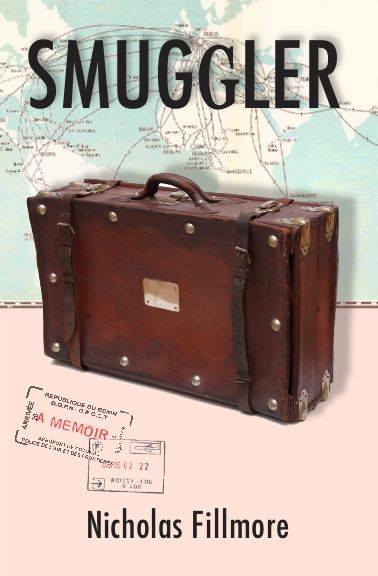
Smuggler
by Nicholas Fillmore
Author Nicholas Fillmore stops by today for an interview and to share an excerpt from Smuggler. You can also read my review and enter our exclusive giveaway for a chance to win a $10 Amazon gift card.
Description
When twenty-something post-grad Nick Fillmore discovers the zine he’s been recruited to edit is a front for drug profits, he begins a dangerous flirtation with an international heroin smuggling conspiracy and in a matter of months finds himself on a fast ride he doesn’t know how to get off of.
After a bag goes missing in an airport transit lounge he is summoned to West Africa to take a voodoo oath with Nigerian mafia. Bound to drug boss Alhaji, he returns to Europe to put the job right, but in Chicago O’Hare Customs gents “blitz” the plane and a courier is arrested.
Thus begins a harried yearlong effort to elude the Feds, prison and a looming existential dead end. Smuggler relates the real events behind Orange is the New Black.
Book Video
The author reads an excerpt from Smuggler.
Excerpt
The New Black
Claire called at some point. She’d taken off on another trip without telling me. She needed me to pick up some money in Chicago and bring it to Brussels. As usual the feeling I might be missing out on the action compelled me to drop everything and go to Europe again.
Claire was still pissed that I’d “left her in Bali.” I thought she was losing it. She’d wasted considerable money dragging a lot of people on vacation. Now she had gotten too many personalities involved—new girls she wanted to sleep with. The last thing I was interested in was people’s personalities in the middle of a smuggling trip. And I was irked to learn that she’d sent Brad and Ted, my people, down to Jakarta without telling me. Alhaji had said we should wait, so what were we doing in Brussels all over again?
Claire had this new girl with her, Temper, a 23-year-old Smith grad and general pill who worked as a waitress at a local pub. She’d tagged along on the last trip with Claire; the whole $20,000 Bali diversion, I suspected, was to impress her.
Temper could have been a smuggler: by day blonde ponytail, pearls, little cocktail dress from Bergdorf’s—except at night something Irish came out: a streak of orange hair, a sharpness of tongue. She called me a pussy once.
Now she hung around the hotel room while Claire and I talked business, the two of them edging onto the bed every few hours to commence their lovemaking.
Cries, moans, little shrieks escaped their throats as they tussled to see who was on top. Claire finally went down on Temper, who whimpered like a Japanese porn actress before she came. Claire sat up with a triumphal look; Temper whipped her hair around, a look of hot shame on her face.
Afterwards, Claire gazed out the hotel window as Temper jogged across the sooty, cobbled square in spandex and splashy cross-trainers, ponytail swinging jauntily. Claire ground out her cigarette.
“Her and that goddamn ponytail,” she muttered.
I had no idea women this way could be so adversarial.
All this was just a distraction. The halcyon days of money and hotels and the belief that we’d found an “out” from the drudgery of low wages, meaningless toil and rules were collapsing under their own weight(lessness) and some vaguely felt second act in which we might be called upon, if only by our own brains, to speak for ourselves, not legally or ethically, but existentially—as we all must—was being wheeled into place. You could smuggle drugs or whatever, but refuse the hand of fate….
We were still in Brussels, waiting on Alhaji’s call. Everyone was drinking in a discotheque across the square. Claire and Temper and Zane and some new boy who kept holding out the sleeve of a sweater for me to touch were sitting on barstools at a high table filled with drinks.
I couldn’t seem to get properly drunk, couldn’t find that sweet spot and was on my fifth drink now; and the faces around me were grinning … as if to assert their reality … against my own. Against my own! I lurched forward, rocking the table. A goblet of wine stood on edge; everyone’s attention fastened on the glass like a roulette ball or a spinning bottle. Then the table rocked back the other way and the glass stood on its other edge. The table rocked a third time and the glass flipped over and the wine shot straight onto this boy’s sweater, blood staining a field of heathers. “Oh!” he cried, like he’d been struck. “Oh!” the others cried. I sat there nodding, a grin slowly taking shape on my face.
Later that afternoon I walked, drunk, through the Musee d’Arte Moderne in Brussels, down a winding white hallway to some inner recess. In a corner, behind glass, a little ventriloquist’s dummy in baggy pants and jacket sat before a brass bell. For minutes on end he just sat there with his feet sticking out in front of him, like he’d been knocked down in the street. Then something seemed to stir inside him and the doll’s torso jerked forward an inch and its metal head—bang! struck the bell producing an unexpectedly bright peal like the bell of a steamship. A little placard read, “Attempt to Raise Hell.” Dennis Oppenheim. American.
A small group waited in anticipation for it to happen again. Just as a couple turned to walk away, bang! the bell clanged again. I stayed for another half hour listening to the intermittent clanging; the little brute kept at it, as if he had a mind of his own—as if, in spite of whatever wind-up mechanism controlled him, he was determined to carry out this errand he alone knew the meaning of.
When I arrived back at the hotel, Claire was arguing with some guy in the hallway whom she’d picked up at the disco then had second thoughts about. He stood there, aggrieved, long hair and ripped jeans, trying to push his way back into the room. I was in the process of telling him to fuck off when he spit right in my face. I stood there blinking as he ran down the three flights of stairs to the street. Then I ran after him and caught him fumbling with his keys in front of the hotel.
He turned to face me.
“Get the fuck out of here,” I screamed.
He looked back at me stupidly, long hair hanging in his face.
“You better get the fuck out of here,” I said in a tremulous voice. For a second it looked like he was going to spit again, and in an access of rage I grabbed him and threw him bodily down onto the sidewalk. He grabbed his hip in pain and scampered into his car, revved the engine insanely, and peeled out on the cobblestones.
Back in the hotel room, Temper was sitting on Claire, pinning her wrists. From behind you could see their pubic mounds touching. I poured myself a Grand Marnier and sat on the couch. Temper pretended to clear her throat and let hang a loogie over Claire’s face.
Heroin was coming; I didn’t know when. For some reason Claire was being cagey. She didn’t know, either. So I went on auto-pilot, certain that this thing didn’t work without the two of us pulling together—as much as she wanted to believe or I wanted to believe or anyone else wanted to believe otherwise.
Claire and I worked well together, not that we necessarily complimented one another. Our relationship was based more on a mutual recklessness. We drove one other, achieving a kind of collective force. (When I told her I wanted to get out on the last trip, she went along out of habit, until Alhaji reeled us back in to do the transit job and Claire came to her senses and started jamming through couriers again, redoubling her efforts in Indonesia and refusing to come home. I’d faltered. I’d said No.)
Claire had no intention of quitting. Whether she was unswayed by reason, like me, or had in fact envisioned some end zone in which she might simply drop the ball and walk away after running up the score, I don’t know. Most likely she was just caught up in a moment that was impossible to sustain, or let go of.
We never did quite know what to do with the money. How to hide it. So we each invested in a project that was dear to us. I dumped money into Squid magazine. Claire restored a carriage house on some friends’ property outside Brattleboro, Vermont—and I suppose I was jealous in a way: while Claire was building equity, I was speculating.
On top of that, Claire was always calling in a panic: The contractor needed more money or he was going to walk off the job. The roof was half-finished and it was going to rain. She needed cherry cabinets or marble counter tops or dry river stones for the fireplace—they had to be dry for twenty years. So I “lent” her the money without complaint. Invariably, in a matter of weeks or months we’d be abroad again, lining up another payday.
You always needed more money. That was the way the world worked, the criminal world as well as the straight world. It was this belated realization that we were involved not in some kind of counter-culture, but another business that organized human endeavor in the service of capital, that rankled.
The trip turned into a long waiting game. This was the worst part of the job. You could run out of money after a week or two waiting for some bags that might never show, all the while trying to keep nervous, suspicious people happy. In the midst of this, Claire and I started to bicker. She mentioned the old term “god’s work.”
“What the fuck are you talking about? We’re smuggling heroin!” I shouted at her.
“That’s not what this is about!” she yelled right back, without missing a beat.
“Oh, right, this is humanitarian work we’re doing, I forgot.”
“You shut up,” she said through clenched teeth.
After that we retreated to separate corners. Claire and Temper whispered conspiratorially. I buried my head in a book.
Finally Alhaji called and said that the only way he could get us bags was in transit. So, on the appointed day, Temper, Claire and I along with a couple other couriers went to the airport in Brussels. We were at a far end of the transit lounge standing against a wall.
A familiar-looking African in a Fila baseball cap came over with another guy, put the bags down and lit a cigarette.
“Hey, how are you guys doing?” he said, smiling.
“Good, good, man,” I said, trying to strike the casual note. “How was the trip?”
“No problem. Alhaji says to call from the other side.”
The people we met in transit were usually pretty competent; Africans who took the bags as far as was safe, usually Western Europe, Brussels in particular. These were Alhaji’s people. They inspired calm, unlike when the bags got farmed out in Jakarta to sweating persons who looked like they’d been on a plane for about 23 hours.
As the two Africans walked away, we looked down at the suitcases. Two bags. Three couriers.
Temper stepped forward. Claire shook her head, No, gesturing for the other two to grab the bags—not so much out of a desire to protect Temper, it seemed to me, as to keep her in her place, and Temper responded with all the choler of the little sister who’s been told she can’t hang out with the big kids.
She hissed. She stamped her foot.
Claire assumed an attitude of wounded dignity.
They argued back and forth in plaintive tones, fists clenched at their sides.
“Tell her to shut up,” I finally said to Claire, the two of them looking up, blushing. And I decided right then and there that I’d had it with the whole fiasco.
Safely stowed aboard the plane, we made our way back to Chicago without further incident, came through customs, took a cab into town, checked into a hotel and made the exchange.
Everyone was dancing at Octagon: Ted shaking dice and showing his ass, Brad in high heels arranging invisible gothic tresses, and Temper stomping in puddles. I couldn’t seem to make my feet move. Claire wasn’t talking.
I went out on the street and looked at the single-story brick buildings. Low clouds scudded off the lake, and the light shifted, turning everything sepia.
If you’d asked just then what I thought I was doing standing out on the street drunk like that in the middle of the afternoon, I would’ve said without irony or self-deception that it wasn’t me.
—You got the wrong guy, pal.
[Want more? Click below to read a longer excerpt.]
Praise for the Book
“Smuggler tells the real story behind Orange is the New Black. The story is a good one and is well written along with being a good moral lesson. It would work for both memoir readers and true crime readers.” ~ Valerity (Val)
“Filmore weaves a hypnotic tale of drugs, crime, prison, and existential angst against a backdrop of poetic Cape Cod nostalgia and international intrigue. An instant classic.” ~ Z. Goode
“Interesting read with a moral undertone. The book starts glamourous and slow and then accelerates into a dark world where actions have consequences. Nigerian gangsters, black magic, international travels, heroin smuggling, moral justifications and a descent into the inevitable. Excellent writing, believable characters, somehow short on action and long on minor details, but all in all an interesting read narrated by a very competent writer.” ~ Santiago D.
“Nicholas needs money badly since the rent is due, but he struggles with his conscience. It’s international drug smuggling after all. Plus there’s a lot of risk involved, depending on the country it could be as high as death. It’s quite a dilemma, the money is insanely good. The situation soon gets hairy and turns out to really be about smuggling heroin.” ~ Alycia C.
My Review
By Lynda Dickson
Nicholas falls into the heroin smuggling business almost by accident, as it seems like a good way to make easy money quickly. So it begins, but things eventually start to fall apart. Good times are followed by increasing paranoia, friendships turn to rivalries, and romance is ruined by lies. Feeling that things are coming unstuck, Nicholas becomes more and more reckless, until his inevitable arrest. The second half of the book covers the time he spends behind bars, the array of interesting characters he meets in various government facilities, and his eventual release.
This isn’t your usual run-of-the-mill true crime story but a work with true literary style. The author is obviously well-educated and has a tremendous vocabulary, although there are a few minor editing errors. The current-day story is interspersed with reminiscences of his “criminal” activities as a child, which serve to humanize him, as does his relationship with his girlfriend L (to whom the book is dedicated). Even though we know that Nicholas will eventually get caught, the story is still suspenseful because we don’t know when it will happen or under what circumstances.
I would have liked more of an idea of the passage of time, as the period over which Nicholas performs his criminal activities and the length of his imprisonment aren’t made clear. I was surprised at one point to discover he spent four years in prison before he was even sentenced. While the story is very well-written, it feels a bit light-hearted given the subject matter. I would have preferred some more introspection from the author on the impact of his actions on those around him and, perhaps, some indication that he regrets his actions, further to his feeling of the loss of six years of his life. I get the impression he’s holding back, which may be a coping mechanism and, therefore, understandable.
An engrossing cautionary tale for our times.
Warnings: coarse language, criminal activity, drug use, excessive alcohol consumption, LGBT themes, sexual references.
Some of My Favorite Lines
“… she composed herself not in sentences or in paragraphs but in chapters …”
“… I understood that we’re always attempting to pass ourselves off in one way or another (with the exception of the impossibly stupid and well-born, who go through life with apparent ease).”
“I awoke halfway through the front door, flat on my back, feet resting on the threshold, of a cold, Catholic Sunday morning in Massachusetts, December light the color of bricks bruising my face.”
“… we muddled through with a good deal of ambivalence between us, and things unsaid, like unexploded mines overgrown with weeds.”
“The tragedy of our lives is not its flaws, but the longing for some perfection held briefly in our hands.”
“I sat there now before the bottles and mirrors swallowing a regret lodged in my throat.”
“Words, words, words. I went through books at a prodigious rate. Four, five a week. The words just went right through without any particular sensibility to oppose them.”
“… you hoped to find a Signet Classic or two on the woeful little carts they rolled through the unit, in order to lose yourself on some heath in wind and rain at midnight—to lay your mind against a shape, a curve of thought or sensibility, and to be ennobled, yes.”
Interview With the Author
Nicholas Fillmore joins me today to discuss his new book, Smuggler.
For what age group do you recommend your book?
Adult.
What sparked the idea for this book?
Six years in prison.
Which comes first? The character's story or the idea for the book?
A series of unfortunate, real-life events lead
me to the idea for the story. (Or vice versa.)
What was the hardest part to write in this book?
Deciding how to frame an unsympathetic
protagonist (myself). He's not simply an anti-hero; merely a frustrated
idealist … who suspects himself of having reasons. Phillip Lopate's
introduction to The Art of the Personal Essay
provided some ideas for working this out, especially his observation that the
“plot” of the personal essay consists in watching how far the narrator can
descend past psychic defenses toward deeper levels of honesty. Camus's
The Fall and
Orwell's
narrative essays, like “Shooting an Elephant”,
helped me find a rhetorical ground to tell those reasons, you know,
to locate myself in the wrong - as did some schoolboy faith in the sacred
import of books … and the belief that a successful artistic gesture might absolve
one of all sins in the end.
How do you hope this book affects its readers?
I hope it challenges people to look at their
own stuff. The corollary to Lopate's idea about the confessional element in personal
essay is that the reader is finally able to recognize a fault in himself,
initially located safely elsewhere ...
How long did it take you to write this book?
I've been working on it, on and off, since 1990-something.
It started as screenplay, but there was too much inner territory to convey. So
I decided on narrative non-fiction. Still, I tried to limit the narrator out of
distrust of the narrator, letting him back in in queer ways: the objective correlative of the scene in
the museum in Brussels (see video above), projecting myself onto the
ventriloquist dummy. Of course there’s a risk of coming off unrepentant. Of
failing to be apologetic. But you can’t live like that. That’s the human
condition. Hence the Camus quotation at the beginning of the book: “We are all
exceptional cases. We all want to appeal against something! Each of us insists
on being innocent at all cost, even if he has to accuse the whole human race
and heaven itself.”
What is your writing routine?
Burning the midnight oil, man.
As for process,
which is more interesting, I’m a very recursive writer; I read stuff over and
over to get at an idea or rhythm. Reading oneself is really important, in order
to connect all the unconscious motifs lurking in the text.
How did you get your book published?
After a few brushes with publishers big and
small, I did it myself. (I'm actually second or third to market with this book,
and Orange is the New Black
seems to be taking up all the air in the room.) I'm an old hand at desk-top
publishing, so the learning curve wasn't too steep(besides mobi files and weird
halftone screens on my pdfs, but that’s another story).
What advice do you have for someone who would like to become a published
writer?
Find a job that doesn't tax you physically, emotionally,
and intellectually so that you have something left to give after you've
finished the dishes and sat down at your desk.
What do you like to do when you're not writing?
Walk around, read, drink coffee.
What does your family think of your writing?
I think that they respect my passion for it.
Please tell us a bit about your childhood.
I grew up in the suburbs in the 70s playing
backyard sports, riding bikes, listening to the radio, and dreaming of the
great world beyond ...
Did you like to read when you were a child?
Yes. I had a near-complete set of Hardy Boys
and used to look up at the gold-engraved spines of the great books on my
father's shelf with reverence, though I was by no means precocious and didn't
get around to reading those things until much later.
When did you first realize you wanted to be a writer?
In college really. My roommate was an English
major and I took some classes, though I started out a Poli Sci.-Econ major. At
some point a Professor, who was a S. Korean political dissident, impressed upon
me that meaningful social change comes from cultural change. Coca Cola and
Levi’s had as much to do with the fall of the Berlin Wall as Reagan. And I began
to see in literature something more than just words ... though, of course,
radical writing has more to do with radical poetics than radical politics;
that's a writer's primary obligation: to remake the world through the
imagination. And I guess writing turns out to be central to me somehow.
Did your childhood experiences influence your writing?
I was a dreamy kid, given to long, inward
afternoons ... even if I was playing street hockey at the time.
Which writers have influenced you the most?
Do you hear from your readers much?
Not yet!
What can we look forward to from you in the future?
I'm working on a family romance of sorts
called Sins of our Fathers,
which attempts to imagine inner events of family characters over several
generations. Personal historical fiction.
Thank you for taking
the time to stop by today, Nicholas. I look forward to reading your next book!
Thank you, Lynda!
About the Author

Nicholas Fillmore attended the graduate writing program at University of New Hampshire, was a finalist for the Juniper Prize in poetry and co-founded and published SQUiD magazine in Provincetown, Massachusetts.
Giveaway
Enter our exclusive giveaway for a chance to win a $10 Amazon gift card.
Links