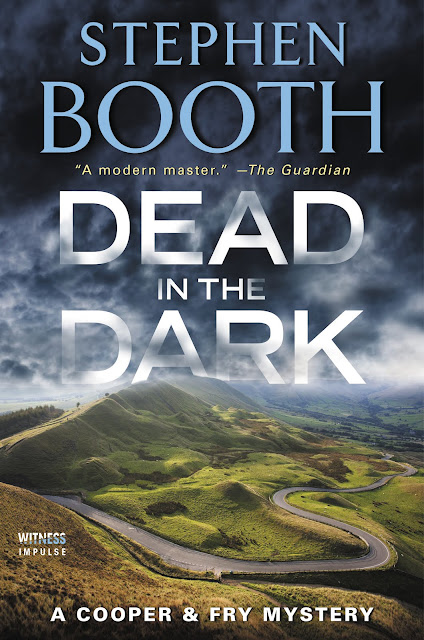
GUEST POST and GIVEAWAY
Secrets of Death
(Cooper & Fry Mystery Book 16)
by Stephen Booth
Description
Residents of the Peak District are used to tourists descending on its soaring hills and brooding valleys. However, this summer brings a different kind of visitor to the idyllic landscape, leaving behind bodies and secrets.
A series of suicides throughout the Peaks throws Detective Inspector Ben Cooper and his team in Derbyshire’s E Division into a race against time to find a connection to these seemingly random acts - with no way of predicting where the next body will turn up. Meanwhile, in Nottingham Detective Sergeant Diane Fry finds a key witness has vanished ...
But what are the mysterious Secrets of Death?
And is there one victim whose fate wasn’t suicide at all?
Excerpt
Chapter 1
Day 1
And this is the first secret of death. There’s always a right time and place to die.
It was important to remember. So important that Roger Farrell was repeating it to himself over and over in his head by the time he drew into the car park. When he pulled up and switched off the engine, he found he was moving his lips to the words and even saying it out loud – though only someone in the car with him would have heard it.
And he was alone, of course. Just him, and the package on the back seat.
There’s always a right time and place to die.
As instructed, Farrell had come properly equipped. He’d practised at home to make sure he got everything just right. It was vital to do this thing precisely. A mistake meant disaster. So getting it wrong was inconceivable. Who knew what would come afterwards? It didn’t bear thinking about.
Last night, he’d experienced a horrible dream, a nightmare about weeds growing from his own body. He’d been pulling clumps of ragwort and thistles out of his chest, ripping roots from his crumbling skin as if he’d turned to earth in the night. He could still feel the tendrils scraping against his ribs as they dragged through his flesh.
He knew what it meant. He was already in the ground. Ashes to ashes, dust to dust. Wasn’t that what they said at your graveside as they shovelled soil on to your coffin? The dream meant his body was recycling back into the earth. In his soul, he’d already died.
Farrell looked around the car park. There were plenty of vehicles here. Although it was the middle of the week, a burst of sunny weather had brought people out into the Peak District in their droves. They’d come to enjoy the special peace and beauty of Heeley Bank, just as he had.
Of course, in many other ways, they weren’t like him at all.
He let out a sigh of contentment. That was the feeling this scenery gave him. The green of the foliage down by the river was startling in its brightness. The farmland he could see stretching up the sides of the hills was a glowing patchwork between a tracery of dry-stone walls. Cattle munched on the new grass in the fields. Further up, a scattering of white blobs covered the rougher grazing where the moors began.
The sight of those sheep made Farrell smile. He’d always associated them with the Peaks. This landscape wouldn’t be the same without sheep. They’d been here for centuries, helping to shape the countryside. And they’d still be here long after he’d gone.
It really was so green out there. So very green.
But there’s always a right time and place.
A silver SUV had pulled into a parking space nearby. Farrell watched a young couple get out and unload two bikes from a rack attached to their vehicle. One of the bikes had a carrier on the back for the small girl sitting in a child seat in the car. She was pre-school, about two years old, wearing a bright yellow dress and an orange sun hat. Her father lifted her out, her toes wiggling with pleasure as she felt the warm air on her skin. The family all laughed together, for no apparent reason.
Farrell had observed people doing that before, laughing at nothing in particular. He’d never understood it. He often didn’t get jokes that others found hilarious. And laughing when there wasn’t even a joke, when no one had actually said anything? That seemed very strange. It was as if they were laughing simply because they were, well . . . happy.
For Roger Farrell, happy was just a word, the appearance of happiness an illusion. He was convinced people put on a façade and acted that way because it was expected of them. It was all just an artificial front. Deep down, no one could be happy in this world. It just wasn’t possible. Happiness was a sham – and a cruel one at that, since no one could attain it. All these people would realise it in the end.
With a surge of pity, Farrell looked away. He’d watched the family too long. Across the car park, an elderly man hobbled on two sticks, accompanied by a woman with a small pug dog on a lead. She had to walk deliberately slowly, so that she didn’t leave the man behind. The pug tugged half-heartedly at its lead, but the woman yanked it back.
These two had probably been married for years and were no doubt suffering from various illnesses that came with age. Did they look happy? Farrell looked more closely at their faces. Definitely not. Not even the dog.
He nodded to himself and closed his eyes as he leaned back in his seat. His breathing settled down to a steady rhythm as he listened to the birds singing in the woods, the tinkle of a stream nearby, the quiet whispering of a gentle breeze through the trees.
As the afternoon drew to a close, he watched the vehicles leave one by one. People were taking off their boots, climbing into cars and heading for home. All of them were complete strangers, absorbed in their own lives. They could see him, of course. An overweight middle-aged man with a receding hairline and a distant stare. But they would never remember him.
A few minutes later, a young man jogged past on to the woodland path, checking his watch as he ran, as if he knew the time was approaching. A black Land Rover eased into a spot opposite Farrell’s BMW, but no one emerged.
***
And finally, the lights went off in the information centre. A woman came out and locked the front doors. She took a glance round the car park, seemed to see nothing of any interest to her, and climbed into a Ford Focus parked in a bay reserved for staff. Farrell watched as she drove away.
When it was quiet and there were only a few cars left, he leaned over into the back seat and unzipped the holdall. Carefully, Farrell lifted out the gas canisters, uncoiling the plastic tubing as it writhed on to the seat. He placed the canisters in the footwell. They looked incongruous sitting there, painted in fluorescent orange with their pictures of party balloons on the side.
It had taken him a while to find the right brand of gas. Some manufacturers had started putting a percentage of air into the canisters, which made them quite useless for his purpose. That was when things went wrong, if you didn’t check and double-check, and make sure you got exactly the right equipment.
Still, you could find anything on the internet, as he well knew. Information, advice, someone to talk to who actually understood how you were feeling. And the inspiration. He would be nothing without that. He wouldn’t be here at Heeley Bank right now.
And this is the first secret of death. There’s always a right time and place to die.
Farrell said it again. You could never say it too often. It was so important. The most important thing in the world. Or in his world, at least.
He reached back into the holdall and lifted out the bag itself. He held it almost reverently, like a delicate surgical instrument. And it was, in a way. It could achieve every bit as much as any complicated heart operation or brain surgery. It could change someone’s life for the better. And instead of hours and hours of complicated medical procedures on the operating table, it took just a few minutes. It was so simple.
With black tape from a roll, he attached the tubing to the place he’d marked on the edge of the bag, tugging at it to make sure it was perfectly secure. Everything fine so far.
Farrell had spent days choosing a piece of music to play. The CD was waiting now in its case and he slid it out, catching a glimpse of his own reflection in the gleaming surface. He wondered what expression would be in his eyes in the last seconds.
Despite his reluctance to see himself now, he couldn’t resist a glance in his rearview mirror. Only his eyes were visible, pale grey irises and a spider’s web of red lines. His pupils appeared tiny, as if he were on drugs or staring into a bright light. And maybe he was looking at the light. Perhaps it had already started.
The CD player whirred quietly and the music began to play. He’d selected a piece of Bach. It wasn’t his normal choice of music, but nothing was normal now. It hadn’t been for quite a while. The sounds of the Bach just seemed to suit the mood he was trying to achieve. Peace, certainly. And a sort of quiet, steady progression towards the inevitable conclusion.
As the sun set in the west over Bradwell Moor, a shaft of orange light burst over the landscape, transforming the colours into a kaleidoscope of unfamiliar shades, as if the Peak District had just become a tropical island.
Farrell held his breath, awed by the magic of the light. It was one of the amazing things he loved about this area, the way it changed from one minute to the next, from one month to another. Those hillsides he was looking at now would be ablaze with purple heather later in the summer. It was always a glorious sight.
For a moment, Farrell hesitated, wondering whether he should have left it until August or the beginning of September.
And then it hit him. That momentary twinge of doubt exploded inside him, filling his lungs and stopping the breath in his throat until he gathered all his strength to battle against it. His hands trembled with the effort as he forced the doubt back down into the darkness. As the tension collapsed, his shoulders sagged and his forehead prickled with a sheen of sweat.
Farrell felt as though he’d just experienced the pain and shock of a heart attack without the fatal consequences. His lips twitched in an ironic smile. That meant he was still in control. He remained capable of making his own mind up, deciding where and when to end his life. He was able to choose his own moment, his own perfect location.
There’s always a right time and place to die.
Roger Farrell took one last glance out of the window as the light began to fade over the Peak District hills.
The place was here.
And the time was now.
[Want more? Click below to read a longer excerpt. Please note the US and UK editions have different covers.]
Praise for the Book
"Can hardly wait for the next one, and the next one. Love reading about this far away place (from me), engaging characters, places, and always well plotted." ~ fj
"Ben Cooper is a very patient investigator. He knows his territory very well. This is my 16th Cooper and Fry and I have loved them all." ~ Mary L
"love love love these books!" ~ Rebecca J. Owens
"Loved it, as always." ~ curlyred
"Booth's prose is polished and mesmerizing. He paints a verbal picture of the Peaks region that is really captures the reader. His characterization, at least of the major characters are definitive and realistic. I do like the bizarre relationship between Cooper and Fry, a love/hate kind of thing that attracts them together and then repels. The plot of Secrets of Death is fairly unique, with plenty of twists." ~ AvidMysteryReader
Guest Post by the Author
My Role as Library Champion
People often ask me how long I’ve been a writer. And the answer is "Always". My very first job after leaving college was as a trainee newspaper reporter, and I worked in journalism for a quarter of a century. Seventeen years ago I left the newspaper business, and now I’m one of those very lucky people who are able to make a livelihood writing novels. The Cooper and Fry series has been very good to me!
So I’ve never done anything else for a living but writing and editing. I’ve never thought of doing anything else. And some people – probably including my wife – would say that I’m not capable of doing anything else!
Yet you would never have expected this from my childhood. Surprisingly for someone who’s grown up to become a professional full-time author, as a child I grew up in a house that had almost no books in it. My parents didn’t read books. And it never seemed to occur to them it was something to encourage in their children either. But for me, once I’d learned the skill of reading, I wanted to read everything I could get my hands on. You know, when you’ve discovered this wonderful new ability you want to be able to use it, don’t you?
There were actually just two books which were available to me in our house when I was growing up. One of them was a Bible, of course. And the other was a book on fortune telling (no, I’m not sure why it was there either!). They were both big, heavily bound volumes with embossed covers, and wonderfully tactile. I can still feel them in my hands now when I think about them. I devoured every word of those two books, because they were all that was available to me. So I very soon found that I knew all the stories in the Old Testament, and I knew how to read fortunes from tea leaves or hold a séance.
Then one day, when my parents were out, I searched the house to try to find something else to read. And hidden away under some spare bedding I found another book. It was a copy of George Eliot’s Silas Marner. I was very young, but the fact that it was a novel created one of those "light bulb" moments you get in life sometimes. A light went off in my head telling me that somewhere there were endless fictional worlds waiting for me to discover as a reader.
But where was I going to find those books that I craved? My parents couldn’t have afforded to buy them, even if they wanted to. The only place I knew there would be books was in my local public library. So I pestered my parents until they enrolled me in the library, and I made sure they enrolled themselves too – not because I expected them to go to the library, but so I had adult tickets to use. I worked my way through the children’s section very quickly and soon moved on to the adult books, literally reading everything that caught my eye. Once I had access to that library, I just read and read and read.
So that little branch library was where I gained my love of books and reading. All those stories I read encouraged me to start writing my own at a very young age, and I completed my first novel when I was around 12 or 13 years old, resulting in the stupendous moment when I knew with certainty that I was going to be a writer when I grew up.
And not only that - a large part of my early education took place in that library, or through the books I was able to get access to. It made a huge difference to me as a child, and gave me a fantastic start in life. It enabled me to go on to get a good academic education, and I became the first member of my family to gain a university degree.
When I look back, I’m completely convinced that I wouldn’t be where I am now, earning a living as a successful writer, without the existence of that little branch library. It was an absolute life changer.
This is why I’m always sad and angry when I see public libraries closing, as they are all over the UK at the moment. I’m sure there must still be kids out there who, like me, don’t have access to books without the existence of a local library. By cutting the library service, we’re damaging the future potential of those young people. And libraries fulfil many other functions too. The poor, the elderly, the disabled, the unemployed – not to mention refugees and asylum seekers - are all disproportionately heavy library users. These are one of the few places where people from all sections of society can mix together in a safe and welcoming environment.
So I’ve been trying to do my bit for libraries ever since I was published and found myself in a position to help. I’ve done many library events over the years, visiting all parts of the UK, and a couple of libraries in the USA, too. Library staff know that author events bring people in, many of whom might never have visited their library before. I love meeting readers, of course, and as a writer I regard libraries as an essential asset, because they’re where readers discover new authors and can try a book by someone they’ve never heard.
Incidentally, we’re also lucky here in the UK that we have Public Lending Right, which pays out a small amount per loan to the author. A few thousand pounds each year from PLR can be a lifeline for many writers.
So I believe we should all be supporting libraries. Because of my publicly voiced support, I’ve been asked to take on roles for several library authorities in the Yorkshire and East Midlands regions of England. I love the title of "Library Ambassador"! I’ve opened new libraries, helped to raise funds for struggling branches, talked to readers about the importance of their library, and been a guest speaker at a Rotary International conference to raise awareness of the crisis facing the service. A few years ago I was appointed a Library Champion in support of the UK’s "Love Libraries" campaign. I’ve been sent by the British Council to represent English literature at the Helsinki Book Fair, and I’ve done online chats for World Book Day. I also visit prisons each year to talk to groups of inmates. Long-term prisoners are among the people for whom access to books and reading is most important.
Sadly, like everything else, money is very tight these days. Many libraries won’t survive without our support, and I think authors have a crucial part to play. We all owe a debt to libraries in one way or another, whether it’s in their role bringing books to the attention of readers, or in the life-changing way that my branch library was so important to me all those years ago. I’m thrilled and honoured to be in a position to give something back.
Oh, and that little branch library where I spent so much time as a child? I’m sorry to say that it closed years ago.
About the Author
A newspaper and magazine journalist for over 25 years, Stephen Booth was born in the English Pennine mill town of Burnley. He was brought up on the Lancashire coast at Blackpool, where he attended Arnold School. He began his career in journalism by editing his school magazine, and wrote his first novel at the age of 12. The Cooper & Fry series is now published by Little, Brown in the UK and by the Witness Impulse imprint of HarperCollins in the USA. In addition to publication in the US, Canada, Australia, and New Zealand, translation rights in the series have so far been sold in sixteen languages – French, German, Dutch, Italian, Swedish, Danish, Finnish, Norwegian, Spanish, Portuguese, Russian, Czech, Romanian, Bulgarian, Japanese, and Hebrew. Stephen left journalism in 2001 to write novels full time. He and his wife Lesley live in a village in rural Nottinghamshire, England (home of Robin Hood and the Pilgrim Fathers). They have three cats.
In recent years, Stephen Booth has become a Library Champion in support of the UK’s "Love Libraries" campaign, and a Reading Champion to support the National Year of Reading. He has also represented British literature at the Helsinki Book Fair in Finland, filmed a documentary for 20th Century Fox on the French detective Vidocq, taken part in online chats for World Book Day, and given talks at many conferences, conventions, libraries, bookshops and festivals around the world.
Giveaway
Enter the tour-wide giveaway for a chance to win one of three ebook copies of Secrets of Death by Stephen Booth.
Links